
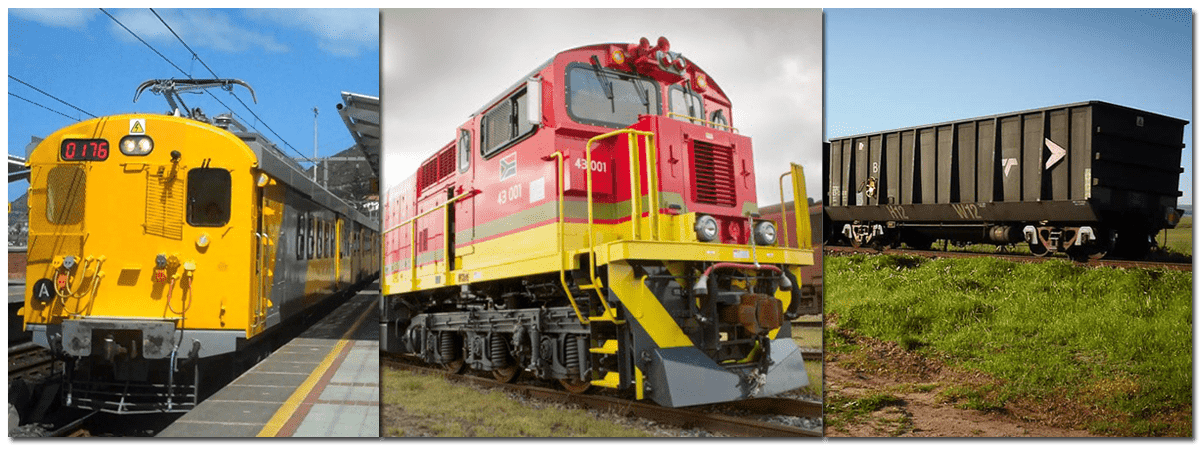
Passenger coaches work hard. Suburban train sets make many short trips a day, with doors opening and closing at every station and thousands of passengers using the seats, handrails and floors. Main-line coaches cover long distances with heating, lighting and other systems running for hours. Both kinds of coach need a steady supply of spare parts, and many fleets in southern Africa include older vehicles whose original suppliers no longer exist.
This guide looks at the main coach systems, the parts that need the most attention, and practical ways to keep passenger rolling stock supplied.
The main coach systems
Bogies and suspension
Coach bogies carry the body on primary and secondary suspension designed for ride comfort as well as safety. Parts include:
- wheelsets and axle bearings;
- coil springs, rubber elements and, on many designs, air springs;
- dampers;
- bogie frame wear parts, such as liners, bushes and pins;
- traction links and anti-roll components, depending on the design.
Brakes
Coaches use air brakes, often with tread brakes or disc brakes. Spares include brake blocks or pads, brake cylinders, valves, rigging parts, hoses and fittings.
Doors and door gear
Doors are one of the most heavily used systems on a passenger vehicle, especially in suburban service. Door leaves, hinges, rollers, guides, seals, locks, door engines or actuators, and the switches that prove a door is closed all wear and need replacing.
Couplers and gangways
Couplers, buffers where fitted, draft gear and the gangway connections between coaches all wear in service.
Interiors
Seats and seat frames, grab handles and handrails, interior panels, luggage racks, windows and floor coverings are exposed to heavy use and sometimes vandalism.
Electrical equipment
Lighting, auxiliary power supplies, batteries and chargers, fans, heaters and air conditioning, passenger information equipment, and the wiring, switches, relays and contactors that connect them. Our guide on sourcing locomotive electrical and electronic parts applies to coach equipment too.
Carbody and underframe
Steps, step boards, handrails, body panels, underframe brackets, equipment boxes and covers.
Parts that need the most attention
Safety-related parts
Doors, brakes, couplers and running gear directly affect passenger safety. Their parts must meet the specifications in the fleet's maintenance rules, and any change of source or design should be approved by the responsible engineer.
High-use parts
Door rollers, guides and seals, seat components, handrails and grab handles, and brake blocks are replaced often. Keeping a reasonable stock of these avoids coaches being withdrawn for minor faults.
Parts for older fleets
Coaches can stay in service for decades. Over that time, original suppliers close or stop making parts. Interior fittings, door components and electrical items are often the first to become unavailable.
Options when a coach part is hard to find
When the original part cannot be bought, there are several routes:
- Global sourcing. Another supplier may still make the part, or an equivalent. Deomac has reliable OEM suppliers across the globe and supplies wagon and coach parts as well as locomotive spares.
- Re-engineering. A part can be designed, developed and manufactured from a sample, a drawing or a part number. This suits brackets, fittings, hinges, mechanical door parts and many interior and carbody parts.
- Local fabrication. Steps, handrails, frames, panels and brackets can be made by laser or plasma cutting, CNC pipe and tube bending, welding and fabrication.
- Machining. Pins, bushes, rollers and similar parts can be turned or milled from bar in batches.
For running gear, see rail vehicle springs: inspection and replacement, which covers coil and air springs.
Plan for the coach overhaul cycle
Coaches are usually maintained to a schedule of inspections and heavier overhauls. To keep parts from holding up that schedule:
- List the parts each overhaul type actually uses, based on past overhauls rather than only the manual.
- Order long-lead items early, especially imported and made-to-order parts.
- Keep samples of awkward parts. When a part is hard to source once, keep a good example so it can be re-engineered next time.
- Batch common parts across the fleet, so that machined and fabricated parts are made in economical quantities.
- Record part numbers and drawing references for each coach type, so every enquiry starts with complete information.
How Deomac can help
Deomac has supplied the African rail industry for over 35 years from its head office and manufacturing plant in Johannesburg, covering locomotive, wagon and coach parts. Its services include re-engineering, global trade, on-site technical advice, laser and plasma cutting, welding and fabrication, CNC turning, pipe and tube bending, and milling.
To find or quote a coach part:
- search the Deomac parts list by drawing number, Deomac number or description;
- send the part or drawing number, a description, photos, quantities and the required date through the contact page;
- if no number is available, mention that you have a sample or drawing so the team can advise on re-engineering.
Summary
Coach maintenance depends on a wide range of parts, from safety-critical brake and door components to seats, handrails and lighting. Separate safety-related parts from general ones, stock the high-use items, and plan for the parts older fleets will lose first. When the original supplier is gone, global sourcing, re-engineering and local fabrication keep passenger coaches in service.
- coach parts
- passenger rolling stock
- carbody parts
- door gear
- rail maintenance